
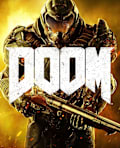
DOOM (2016)
Inside the DOOM Score – Mick Gordon Interview
DOOM (2016)
Like any great composer, Mick Gordon began with a full immersion into the essentials of his subject matter. For Gordon, that meant traveling from his home in Australia to id Software’s Dallas-based studio, having some good old-fashioned Texas BBQ with the developers… then slaying each other in heated rounds of Team Deathmatch. It’s all in a day’s work for Gordon, who then got started on crafting the score for DOOM.
{.center}
The good news? The meaty combination of brisket and brute force helped inspire Gordon to craft a killer soundtrack that not only helped set the tone for the game, but quickly became a new fan-favorite. With the community clamoring for an official soundtrack release, Gordon set to work on rebuilding the score (more on that below). With 31 tracks and 128 minutes of extended, standalone tracks, the DOOM Original Game Soundtrack will be available today on iTunes and Spotify.
We caught up with Gordon to find out more about his Argent-infused soundtrack – and what gives his music such a “spicy” kick. Meanwhile, to celebrate DOOM and its music, we’ve released a full version of the score on YouTube for you to listen to right now. (But be sure to head to iTunes or Spotify to get the full-fidelity DOOM soundtrack, complete with all the individual tracks.)
The newly released soundtrack isn’t just the files from the game. You actually composed fuller, standalone tracks, extending each song or theme. Tell us about that process.
I wanted to give the fans the best possible representation of the music. When you’re making music for a videogame, often the music is broken apart into lots of tiny pieces like a giant jigsaw puzzle. The game engine stitches these puzzle pieces together depending on what the player is doing. It’s always different; you’ll get a different hacked-together song if you’re exploring, or fighting a lot of demons, or fighting a few demons, or a boss, or low on health, etc. It works really well for videogame music, but the downside is that there really aren’t any individual “songs” to listen to. So, for this soundtrack release, I took these little puzzle pieces and filled them out to create full songs, just like I would have if I were creating an album of DOOM music.
How do you compose a soundtrack for a game that’s all about relentless, push-forward combat?
Haha! Well, you take angry 7, 8 and 9 string guitars, vintage Soviet synthesizers and punch-knuckle-smacked drums. Then, you spice it up with burning valve distortion, electrically starved transistors, dusty ancient reel-to-reel tape machines, bleeding feedback arrays and gut-grinding sub-woofers. Finally, you smash all these elements together, give the player a shotgun and let the hunt begin!
{.center}
What kind of access did you have to the game in order to compose your tracks?
I got the chance to visit the id Software offices for two days and hang out with the awesome audio team: Chris [Hite], Chad [Mossholder] and Ben [Carney]. It was great. We basically ate BBQ, geeked out on synths and murdered each other in Team Deathmatch. We talked a lot about finding a new sound for DOOM. Something that represented the DOOM universe as a whole – that propelled the action and kept an aggressive, punchy edge. Throughout development the team would send me videos and concept art. Each time they sent through something new, my head would explode with ideas.
Was there anything in particular that really inspired your unique approach to the soundscapes for DOOM?
The UAC and their use of the forces of Hell as a source of energy – Argent energy – was really interesting. Imagine what that would be like: your phone, your car, airplanes, drones, defense systems, the stock market, pacemakers, all being run on Hell energy. This led to the idea of corrupting audio signals through various ways, such as broken circuits, speakers being forced to play sounds so loud that they tear apart, electromagnetic interference messing with old cassette tapes, etc. A whole palette of gritty sounds were born out of that concept of Argent energy.
So much of the soundtrack is built on driving rhythms and percussive force. Why so?
DOOM is a very visceral, in-your-face, gut-punching experience. It’s primal. There’s something instinctual about drums, and I like drums that hit just as hard as the DOOM Marine. When you’re playing the game, the flow is very important. The music supports this flow with a solid groove and the percussion plays a very important role in propelling the on-screen action.
{.center}
You also have a unique approach to dissonant sounds. How do you include these in a way that isn’t too jarring, but still captures that feeling of chaotic combat?
It’s a lot like cooking. Once you’ve got a good, solid, hearty meal you can give it an extra kick with a bit of chili. So, with music, you focus on creating a good solid groove to begin with and then add a bit of Hellish Habanero afterward. DOOM likes a lot of chili.
But just like too much chili could burn out someone’s taste buds, how do you create tracks that keep players excited without “burning them out”?
I think the key is throwing the player a constant stream of new musical ideas. DOOM is a very dynamic game that forces you to keep moving, judge your surroundings, be strategic in weapon choice and position, manage your health, armor and ammunition resources… there’s a lot to focus on. Musically, we attempt to reward the player with changes – the music might get heavier, or more groovy, or a cool distorted synth line might start, etc. It’s all positive reinforcement designed to make the player feel badass.
Do you have a favorite song from the soundtrack? What and why?
BFG Division was one of the first ideas that popped into my head when I visited the id Software offices and it was inspired by the giant laser room where the BFG is hiding. I had a fantastic time working with the Titan monologues and used them to create an homage to ’70s and ’80s concept albums that tell the story of the protagonist (I. DOGMA, II. DEMIGOD, III. DAKHMA, IV. DOOM). The final piece of music I produced for DOOM was Mastermind and it combined all the musical techniques and composition processes that were discovered over the two-years of working on the game.
{.center}
Do you have a favorite moment from the game itself? Perhaps something that you feel really came to life in conjunction with your music?
I love the elevator opening over the logos where the team timed the cocking of the Shotgun with the drum hits of “At Doom’s Gate.” That totally wasn’t something I planned on my end – that was all down to the geniuses at id Software! There’s this dramatic scene where you’re forced to watch Olivia Pierce commit some horrible atrocities against the remaining UAC employees. Musically here, I used a track from the original Doom [1993] soundtrack, “Suspense,” and reworked it. It worked really well as a theme for Olivia. The fact that “Suspense” still works well today in a modern setting shows the fabulous power of Bobby Prince’s Doom soundtrack.
Are you surprised at all by how much DOOM fans love your soundtrack? Do you have a favorite piece of fan feedback?
Oh yeah, absolutely! Like the game, the soundtrack was forged with DOOM fans in mind from the beginning. DOOM fans are fabulous. I’ve been completely blown away by all the messages, Tweets, YouTube covers, tattoos, drawings, cakes – DOOM fans rock!
{.center}
What’s next for Mick Gordon?
I’m looking up at my giant whiteboard that hangs above my head and the task list is absolutely colossal. There’s a bunch of stuff to get through – scary aliens, Moon mysteries, killer-robots, anti-gravity acrobatics, trailers, collaborations, live show prep, talks to give…never a dull moment.
