
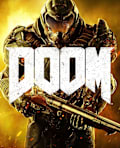
DOOM (2016)
22 Reasons to Love DOOM – Part 2
DOOM (2016)
On Dec.
10, 1993, the original DOOM was released – and the world of gaming has never been the same. To celebrate DOOM’s 22nd anniversary, we’re looking ahead to the new DOOM, with 22 reasons to love the upcoming spring release. Before pushing ahead, be sure to check out Part 1 here!
Shotgun / Super Shotgun
Some of DOOM’s popularity can be attributed to its iconic weaponry, including one of the most iconic of them all: the Shotgun (as well as the Super Shotgun). Originally modeled after a toy (the original still sits in a trophy case in the id Software offices), this powerhouse packed a major punch back in the day, and it still does the dirty work in the new game. “I love the Super Shotgun,” says General Manager Garrett Young. “It wrecks!” Executive Producer Marty Stratton agrees, adding: “The combination of the player’s fast movement speed and the close-range punch of the Super Shotgun make it really fun.” Senior Animator Brett Paton picks the Combat Shotgun as his personal favorite. “I think it looks the best of any shotgun in any game to date – and there have been some good ones out there,” he says. “It looks great and packs a punch. Plus it has a few tricks up its sleeve…”
Deep Bench of Demons
Powerful weapons wouldn’t matter without some ferocious foes standing in your way. DOOM brings back its unruly roster of Demons, including the Revenant, Mancubus, Pinky, Imp and Cacodemon. The team at id looked back to the original games for inspiration, but reinvented these iconic enemies to create something that fits the vision of the new game. And everyone at id has a different favorite. “I really like our new Mancubus,” Stratton says. “He looks great and he’s fun to fight against.” Environment Lead Lear Darocy enjoys how another big baddie has evolved. “The Hell Knight was a very intimidating demon in DOOM 3,” Darocy says. “We brought back everything that made this demon what it is, and pushed that even farther in the new DOOM.” For Young, though, it’s a smaller foe that gives him fits. “Our big guys scare the hell out of me, but the Imps may be my favorite,” Young says. “They stick and move, they shoot you from walls, and on higher difficulties their fireballs will destroy you. Be warned.”
Chainsaw
Yes, it’s back. Yes, it’s as brutal as ever. But this time around it also has a strategic role in the game. Though it has very limited fuel, it’s a one-hit-kill option that will not only brutally eviscerate a demon but also deliver copious ammo – often when it’s needed most.
An Arsenal of Options
For Designer Peter Sokal, DOOM’s core gameplay can be distilled down to a singular notion. “With your speed and weapons, DOOM gives you the tools to be the ‘alpha’ in any encounter,” he says. But, much like the art team (see Part 1), the id design team enjoys a spirit of collaboration that stands in contrast to the lone DOOM Marine. Sokal is especially proud of how the team continually iterates on each other’s work to improve the gameplay experience. “We are constantly getting feedback from one another on our work. This has helped us grow as a team, collaborate more, and ultimately get a better end result in the game.”
It’s all about exploring the best options – a notion that’s reflected in the game itself. “While there are many new things for players to enjoy, a big one is having more options in how they approach combat,” Sokal says. “We have customization elements that can allow for some very different gameplay experiences. I'm very excited to see what types of combinations people come up with.”
Push-Forward Combat
At the core of the gameplay is the notion of push-forward combat – an evolution of what defined the combat in the original DOOM. “Our animation director and his team were the first to really coin this term,” Stratton says. “It was born out of the idea that many FPS games put players on their heels – hiding behind cover, moving backward. DOOM is all about moving forward, being faster than the enemy, and taking the fight to them. So with the combination of using weapons to stagger enemies, the fast closing speed of the character and the violent close-range finishing moves (Glory Kills), we've created something that is highly addictive but fits completely with the tone, speed and style of DOOM.”
“The push-forward style of our combat rewards players for being aggressive and not backing down from a challenge,” Sokal adds. “If you are low on health, charge into the maw and blow a demon in half to get a nice chunk of your health back. Low on ammo? Pull out the Chainsaw and cut a demon apart to get a huge ammo refill. For me, these moments are some of the most satisfying in the game.”
As Young points out, shooting is far from the only thing that matters in DOOM. “What most people don't understand is that the original DOOM wasn't so much about shooting,” he says, “it was about movement. Targeting was easy: there was no reticle. The challenge was to stay alive – and that required movement. Today’s DOOM takes this lesson as gospel. Yes we have a reticle, but if you stay in one place too long, you're done for. DOOM is not a tactical shooter. You want to win? You better move.”
New Single-Player Weapons
Movement might be key to staying alive, but your DOOM Marine still needs all the heavy ordnance he can get his hands on. Along with all the returning (and fully updated) classic weapons, DOOM has two new guns in single-player: the Gauss Cannon and the HAR (heavy assault rifle).
Serious Sounds
It’s not enough to blow away demons. Players want to feel the raw power of being a DOOM Marine deep in their gut. Nothing helps enhance the sensation of utter dominance like great sound design. In fact, that’s the guiding principle for DOOM’s audio team: “To define and deliver an audio experience that is based on the DOOM Marine power fantasy,” says Hite. Tall order indeed, but the team is up to the task. “Our game sounds unique in many ways, and I’m proud of how it stands out,” Hite says. “We have a good mix of the old and new.”
As for what specifically helps bring this power fantasy to life, Hite points to two aspects in particular. First, the weapons: “We are excited for the world to experience what guns sound like in a 2016 DOOM game,” he says. Second, the score: “The musical treatment is the perfect mix of the early standout and often-referenced Bobby Prince tracks,” Hite notes. “It’s also a look forward to what a modern sci-fi shooter should sound like.”
For even more reasons to love DOOM, check out these Bethesda.net feature:
